2009 April
permalinkWelcome to Calgary
April showers? Ha! Taken outside my driveway:
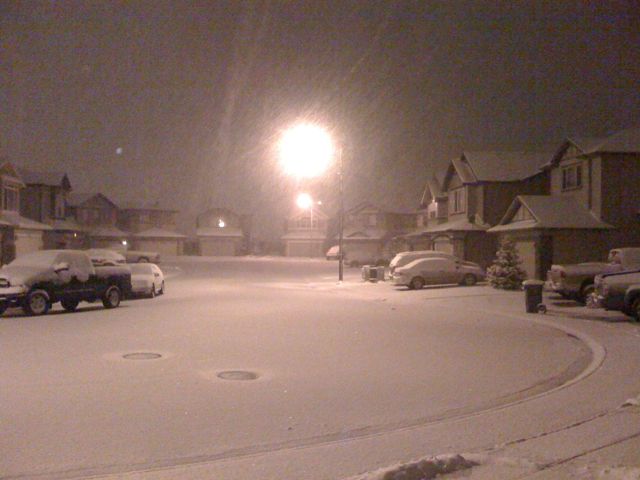
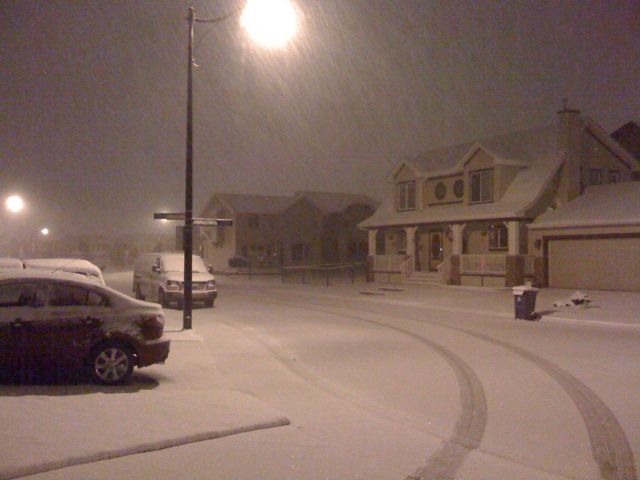
Update: getting heavier now, near white-out at times. Another shot from the Apple iBlurryCamPhone:

Digg's optimized data streams
Digg just released a prototype of their optimized data streams. This this is pretty cool. It uses MIME multipart HTTP responses to return a stream of responses, dispatching each one as it comes in. Bugzilla has been using MIME multipart for a while, though only to serve a short “Bugzilla is searching for your bugs” message before returning the actual results.
The Evolution of a Web Technology
- Obscurity
- Relative obscurity
- Robert Scoble gets it
- The ?-erati get it
- The SEO and marketing “experts” abuse it and annoy everyone
- Oprah ?s on her show
- Soccer moms and your grandma try ?ing
- Charmin Ultra-Soft becomes your friend on ?
- Someone in the ? space gets bought
- Time passes
- Robert Scoble declares that ? is dead
Oracle buys Sun (but really MySQL and Java)
The news that Oracle bought Sun caught me off guard. I was moderately disappointed when they were courting IBM as a suitor, but I would have been more than happy if they had gone through with the deal. IBM understands open-source and has a proven track record in Eclipse.
The final word on Google Eclipse plugin OSX crashes
I’ve blogged about the subject of GWT JVM crashes far too much (here and here). This is, I hope, the final word on the subject. I spent some time disassembling the Google Eclipse plugin (did I agree not to do that in one of the EULAs? ;)) and discovered that they are launching the JVM without using the Eclipse infrastructure. This means that the JVM arguments are effectively hardcoded, except in one case where -startOnFirstThread is passed for OSX clients. For those interested, the buggy classes of note are GWTDeploymentParticipant and LaunchUtils.
AppEngine+Java+OSX "Invalid memory access" on deploy
UPDATE, Apr 19 2009: This does not fix all compiler crashes in Eclipse. This is only useful for the compiler crashes where an Eclipse JVM configuration is used. Please see my later blog post for a better fix and disregard this information.
This is the same error I hit before (see my earlier post), but it happens in Eclipse during the “deploy to AppEngine” phase. You’ll see it if you’ve got a project configured with a 1.6 JVM on the build path (even if your .class compatibility is set to 1.5). It’s not obvious how to fix this at first glance - I had to dig around to find the options that Eclipse passes to the JVM.
The solution
Google eats GWT dogfood
Google’s new profile editor uses GWT, cool!
Looks like they aren’t obfuscating class names yet (a feature that just landed on the tip of trunk, IIRC):
http://www.google.com/s2/gwt/resources/9312606AE1FEAAD063F34A9446584258.cache.js
The name of the project is “com.google.focus” and there are references to codenames: “evergreen” (contact info DB?) and “publicusername”. They are also pulling some of the code from Google Collections into the final output.
GWT 1.6 crashes (and a fix)
There’s a bug in the latest Java 1.6 that Apple provides that gets tickled by the GWT 1.6 compiler. It manifests as a reproducible HotSpot compiler crash that looks like this:
[java] Invalid memory access of location 00000000 rip=01160767
When you look into the crash logs that Java produces (found under ~/Library/Logs/CrashReporter/java_*), you can see that HotSpot was compiling a method when it crashed:
Feedburner slow to update?
I’m having trouble getting Feedburner to update from my server, so feeds aren’t showing up in Google Reader. It’s not pulling down the latest posts, just the ones from yesterday and before. Any ideas?
UPDATE: It would help if I didn’t redirect FeedBurner to its own feed.
Google's Eclipse plugin for GWT and AppEngine
We’ve been trying out Google’s Eclipse plugin for the last week and it’s made a huge difference to our GWT development experience. The plugin is designed to enhance your Java AppEngine and GWT workflow. We’re mainly using it for GWT development, so the biggest wins for us are the GWT features, including:
Note to the Google Reader mobile team
I read all I my feeds through Google Reader. Of all the RSS readers, it is the cleanest and most convenient to use. When I started reading feeds on a mobile device, I was happy to see that the Reader team had put some effort into creating a fantastic mobile experience as well.
There are a couple of minor issues with the product:
Posting on the go
I’ve been a fan of powerful handheld devices for a long time. I bought a Palm Pilot to help me keep track of my university classes in the 90’s and graduated up to a Treo earlier this decade. The iPhone is the first device out of all of them that makes mobile publishing a breeze (and fun too).
There were a few attempts at blog and twitter integration on the old Palm platform, but networking always felt like it was bolted onto the OS, rather than an integral part of the experience.
Yet another blog engine
My Typo installation has been busted for a while– I decided I’d bite the bullet and install WordPress. It’s pretty much the defacto standard for self-hosted blogs and it’s flexible enough for my needs.
This is the fourth iteration of my personal blog. My first was a hand-crafted news page of posts (using pico and an AIX shell, nonetheless) before blogs were called blogs.