2011
permalinkUpcoming Google+ features: hashtag autocomplete, new circle management, and more
I’ve been snooping around the Google+ code a bit and found some more upcoming features.
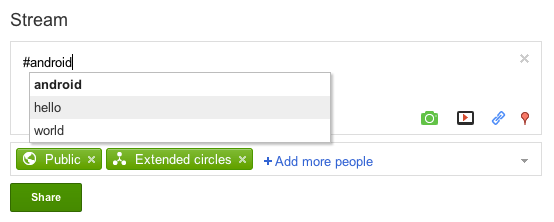
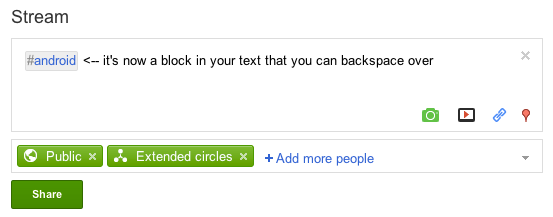
Hashtags are getting a bit of a boost with auto-completion. When you type the hash character, you’ll see a list of potential auto-completions (this doesn’t appear to be hooked up to any data). When you hit space, it turns into a blue block containing the hashtag, which acts like the blue blocks that contain + mentions:
Circle management looks like it might be dropping the circle visual metaphor. The new interface lists your circles on the left, although this wasn’t working very well, so it’s difficult to say what the final result will look like:
Five minutes with the Kobo Vox
 Today I had a chance to play with the Canadian equivalent of the Kindle Fire, the Kobo Vox. It’s an Android 2.3 device, which means that it effectively has access to the entire ecosystem of Android apps. What it lacks, unfortunately, is the official Google Market application. It did appear to have access to the Gmail app, which makes the lack of Google’s Android market surprising.
Automatic file transfer in iTerm2 via ZModem

scp is a great way to securely transfer files from computer to computer, but wouldn’t it be nice if you could just automatically send files over the existing SSH connection you’ve already opened?
Back in the days of modem-based BBSes and dial-up machine access, file transfers were forced to run over the same TTY as your interaction with the system. A number of different solutions evolved for this, starting with the grandfather of transfer solutions, XModem. Other transfer protocols evolved, some starting from the ground up like Kermit, while YModem and ZModem build on the foundation of XModem.
On the advancement of science and the useful arts
Apple is quickly burning my goodwill towards with these silly patent fights. Two out of three of the patents were found not to be infringing, while the last one is a software patent that basically describes the functioning of a mobile device that deals with photos.
At this point, it’s probably worth pointing out that Apple’s notification bar is pretty much a rip-off of the Android one. And you know what? I really don’t care.
Nearing nanojson v1.0
I’m nearly ready to cut a 1.0 version of nanojson. I spent some time merging the two writer interfaces into a single API.
String json = JsonWriter.string()
  .object()
  .array("a")
    .value(1)
    .value(2)
  .end()
  .value("b", false)
  .value("c", true)
  .end()
.close();
There’s a new convenience static for quickly converting stuff to a string as well:
String json = JsonWriter.string(object);
nanojson API
Found some time tonight to flesh out nanojson’s API a bit more. Going to start replacing all the various JSON.org parsers scattered around production code with this to get a better idea of how the API feels.
You’ll find it at GitHub here.
How Apple can make use of ARM (and Intel) in its laptop line
There’s been some speculation about Apple moving to ARM in some of its MacBook products. This has been largely dismissed as pure rumour by a number of folks: the costs to developers of adding another platform to the universal binary format (“universal trinaries”) would be prohibitive. On top of that, the difficultly of emulating x86 or x64-compiled code on a purely ARM platform with reasonable performance would be a very challenging task.
That’s not to say that it’s totally impossible for Apple to take advantage of the potential power savings of making an ARM switch.
Abusing the HTML5 History API for fun (and chaos)
Disclaimer: this post is intended to be humorous and the techniques described in this post are not recommend for use for any website that wishes to keep visitors.
I’ve been waiting for a chance to play with the HTML5 History APIs since seeing it on Google’s 20thingsilearned.com. After reading Dive into HTML5’s take on the History API today (thanks to a pointer by Mark Trapp), I finally came up with a great way to play around with the API.
Teaser: it turns out that this API can be used for evil on WebKit browsers. I’ll get to that after the fun part.
GWT 2.2 and java.lang.IncompatibleClassChangeError
I’ve been updating Gri.pe to the latest versions of the various libraries we use and ran into some trouble while attempting to update GWT to 2.2. There were some incompatible bytecode changes made: the classes in the com.google.gwt.core.ext.typeinfo package were converted to interfaces. Java has a special invoke opcode for interface types, so the classes would fail to load with this obscure error when the verifier tried to load the classes:
java.lang.IncompatibleClassChangeError: Found interface com.google.gwt.core.ext.typeinfo.JClassType, but class was expected
Now that's a prediction
Amusing: IBM’s Jeopardy-winning knowledge bot was named Watson, after IBM’s first president, Dr. Thomas J. Watson.
 In Robert Heinlein’s 1966 novel, The Moon is a Harsh Mistress, one of the main characters is named Mike, nicknamed so after Mycroft Holmes in a short story written by the same Dr. Watson, before founding IBM:
Mike was not official name; I had nicknamed him for Mycroft Holmes, in a story written by Dr. Watson before he founded IBM. This story character would just sit and think—and that’s what Mike did. Mike was a fair dinkum thinkum, sharpest computer you’ll ever meet.
Inception (the ARM implementation)
As a way of getting better acquainted with the ARM-based devices cluttering up my desk, I picked up this gem of a textbook at Amazon:

Reading through the interrupts section reveals an implementation of Inception on the ARM platform:

SSH escape sequences (or "don't kill -9 that process")
Back when I first started SSH (around the RedHat 4.x days), I’d occasionally be connected to another host via SSH when the host or the network connection would suddenly lock up. I’d end up trying to figure out which SSH process was the one that was frozen and kill -9ing it. That is, until someone showed me how to use SSH escape sequences. Occasionally I see people talking about killing frozen SSH sessions and it reminds me to pass on this tip.
A week with a ChromeOS netbook
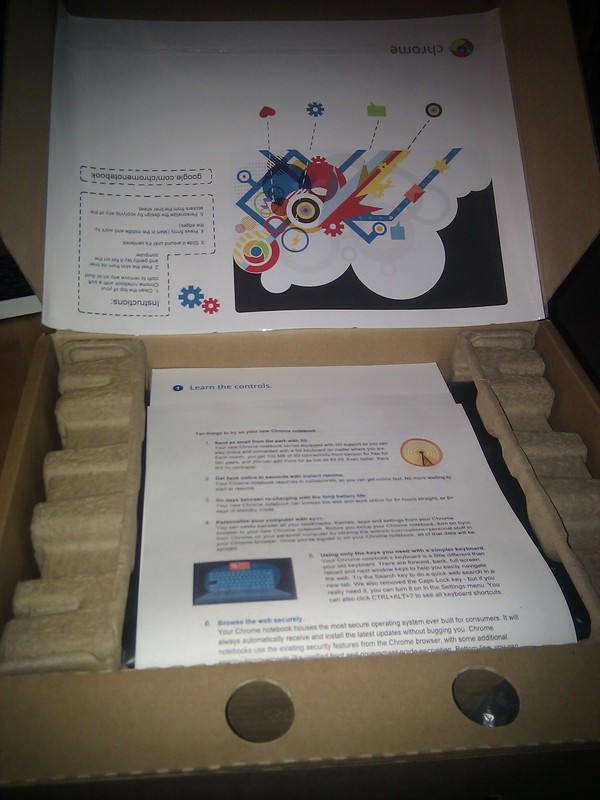
 A box showed up earlier this week in the mail with an interesting set of markings. It wasn’t a big surprise - I’d been eagerly anticipating the arrival of a Cr-48 since it was shipped late last week.
Inside the box was the netbook, a set of instructions and the new set of Cr-48 decals. The decals are pretty flashy and look good, but I figured I’d wait a bit before putting them on (hey, this thing looks pretty good as-is).

The heartbreak of the pivot
(This was originally a response to a question asked of me on Quora, but I’ve copied it here to my blog so I can expand on it)
“Pivot” is a big catchphrase in the startup world these days. It has a glamorous feel to it: you picture the Twitter team dropping Odeo on the ground and moving on to the brand new idea without a moment’s thought. There’s more to it than that.

In May of 2010 we stopped spending all of our resources on DotSpots and started working on our new idea, Gri.pe. By our September launch at TechCrunch Disrupt, we were focusing all of our efforts on it and decided that we’d start the process of shutting down DotSpots.