2004
permalinkPrimus Updates + WRT54GS
After a month of playing around with the Primus service, it’s finally starting to settle into a stable and reliable home-phone system. My major problems in the first few weeks were (in no particular order):
Primus Canada Talk Broadband
I signed up for Primus Canada’s Talk Broadband service last week. Out of all the Canadian VoIP offerings, Primus was the only service I felt was up to the task of replacing our home phone entirely.
Talk Broadband is an MGCP-based offering. This means that all your communication with the outside world goes through a central clearing house. Contrast this with SIP, which is capable of working without a central server.
IE7
Gotta give IE7 some serious Google juice. This has got to be one of the most important hacks of the IE5-6 era. Even after understanding what the magic Javascript does, I’m still amazed that it manages to fix so many of the rendering bugs IE. At some point I’m going to scrap my IE-specific workarounds for this site and just use proper CSS and the IE7 patch for those unfortunately souls stuck with Internet Explorer.
Jersey Girl
This is one of the best Kevin Smith movies so far. I wasn’t really a fan of Dogma or Jay and Silent Bob Strike Back, but I’ve been watching Clerks over and over since it first came out in the mid-90’s. Chasing Amy was also one of my favorites from the View Askew series, but I’ve already strayed from the original topic too much not to end this post right …. now.
Fedora Core 3: Running CVS in a chroot Jail
Setting up a CVS server on a Unix system usually means that you either run CVS in its insecure :pserver: mode or run it over SSH, requiring that the CVS users have a shell account and consequently, full access to your system. The concept of a “chroot jail” is an essential part of isolating remote service users from remote system administrators.
Thanks to the magic of pam_chroot, you can host a full-featured, encrypted and secure CVS server on any server with SSH. Users are able to connect to CVS via SSH but are denied access to any sort of command-line.
pam_chroot is part of the standard PAM modules. It consults /etc/security/chroot.conf for a list of users to be chroot jailed:
Fedora Core 3: Coming Very Soon
Looks like Fedora Core 3 is being pushed to mirrors as we speak I couldn’t find any concrete evidence of a Monday release, but the Fedora Release Schedule does indicate it as a likely target.
The release notes for the last development version are available, but they may have changed for the final release.
I’m guessing that FC3 DVD torrents will appear on the Duke torrent site after the release.
SANE Scanner Setup Weirdness
Getting my scanner up and running was easy enough. The strange part of the whole ordeal is that the RPMs for SANE place all of the config files in /etc/sane.d, but the executables are all looking in /etc! I noticed that the RPM was from the yoper repository - it doesn’t seem to be a core Fedora package. After looking at it more carefully, I think I managed to install a package that doesn’t really fit my installed Fedora Core 2 at all.
More Home-Office Setup Experiences
I just finished setting up dovecot this morning to aggregate my various email boxes and make them available via a single server. Dovecot seems to be a server from the new golden age of Unix services. It’s easy to set up and has reasonable defaults for getting a server up-and-running without much effort. Note that this is in contrast to sendmail configuration, which is as cryptic as could possibly be.
Are People Waking Up to Microsoft?
Are people finally waking up to Microsoft’s attempts to get their fingers in every pie? A few months back, Microsoft managed to kill the IETF Marid working group’s attempts to build a common spam filtering framework by refusing to license their technology openly. This leaves room for SPF to take over, already with the backing of a large number of mail server operators.
Just recently adoption of the WMV9 codec, slated for inclusion in the sequel techology to DVD, is hitting some roadblocks:
Linksys Upgrade Debacle
While upgrading my Linksys router through the upgrade page, I somehow managed to kill the thing. Having spoken with others that have tried to upgrade the firmware, I don’t seem to be alone.
Luckily, the Linksys-modified TFTP program saves the day. It seems that the hobbled router comes up in a crippled mode on 192.168.1.1 with a password of “admin”. Once you re-upload the firmware, it comes back up with the proper settings.
I think the trick is not using the HTML-version of the upgrade page. Stick with TFTP!
Networked Printing in Fedora Core
Networked printing is really cool in Fedora! You can configure CUPS to automatically browse the network and discover other printers by using the Printer Configuration tool and, under the “Sharing…” menu, choose “Automatically find remote shared queues”.
You can even use this to set up a remote print queue for Windows. Install the generic Adobe postscript printer driver and point it to your CUPS printer share when it asks for the URL. The CUPS URLs are generally of the form: http://servername:631/printers/printer-name.
You’ll find the printer URL by browsing the CUPS webpages and selecting the printer under “manage printers”.
Fedora Core Network Install
I decided to pave over my Windows 2000 box with a brand new install of Fedora Core 2. The network install is awesome - burn the 4MB boot.iso to a CD, select “HTTP” install, point it any Fedora mirror and go!
It took about 30 minutes to get the installation completed on my old PII-400. Your time may vary based on CPU hugeness and mirror fastness.
I’ve been using my Linksys firewall for managing internal DHCP, but it doesn’t really give you much flexibility to assign static IPs that I’d like. I hope to get a quick and dirty DHCP server up and running with brand-new DHCP-managed static IP addresses for all of my networked devices (including my Xbox).
Google Desktop Search: How it Works, Pt 1
I tried out Google Desktop Search today and I decided to take a deeper look at how it works and how it integrates into your daily experiences. This information all comes from reverse-engineering and file/registry observation. None of it is guaranteed to be correct.
From looking at some of the PDB file references, I think the internal name of this Google search engine is “Total Recall”. This fits with the replacement string returned from Google (“”) and the port number registry key “trs_port”.
The search utility consists of three main applications and a number of “information provider” plugins. The main applications are:
ASP.NET Security Bug: The Real Information
Has anyone noticed that Microsoft is willing to admit to that “a bug in ASP.NET canonicalization exists”, but refuses to divulge any more information? Considering that the information is easily available and being distributed by bloggers between themselves, you should have all of the information at your fingertips to protect yourself.
Basically, the bug involves subverting Windows or Forms authentication by modifying your URL slightly. By replacing traditional URL slashes with backslashes, you can fool ASP.NET into serving files that should be protected.
Neat Image - Digital Camera Noise Reduction
Neat Image is a tool for automatically reducing digital camera noise. I tried it out last night on a few photos - it manages to clear up a lot of random noise you see when zooming in on most digital pictures. Best of all - it’s free for personal use!
I managed to get results that were pretty good, but not as striking as their examples. I suppose the developers of the tool would understand how to get the most out of it. You’ll notice a subtle difference in the shots that you’ve processed with the tool.
It’s a bit of extra work for each shot, but I think it pays off to clean up the pictures you really like.
Spyware Installing on Fully-Patched XP SP2!
After reading the full-disclosure list for more ASP.NET vulnerability information, I came across a report of spyware installing on fully-patched XP SP2 IE instances.
The thread is here. Basically, a site is forcing a CAB file down user’s throats without any sort notification. If you want to try it out in VMWare or some other safe environment, jump to the URL http://www.themexp.org/about_wrap.php.
I can’t repeat it enough: Install Firefox today.
Microsoft's FAT Patent Rejected
GrokLaw is just reporting that Microsoft’s FAT Patent has been rejected. This is good news! Check out the story on GrokLaw, or read the good bits here:
nprof 0.9a released
I repackaged nprof 0.9 to include the missing msvcr70.dll that didn’t make it in the first time. With any luck, this should fix the issues with loading DotNetLib that people were having.
Web Developer Toolbar
If you use Firefox (you are using Firefox, right?) and you do anything even remotely related to web development - including maintaining a blog - you must download the Web Developer Toolbar.
This toolbar allows you to do everything from disable images to editing CSS live or even viewing response headers.
If you’re editing CSS, it opens a sidebar with the current stylesheets loaded in separate tabs on the left. As you type in each stylesheet, the styles are updated on the page to the right. You can save and load stylesheets for future editing purposes. It’s handy for checking out a site to see how they pulled off a CSS trick.
nprof 0.9 released
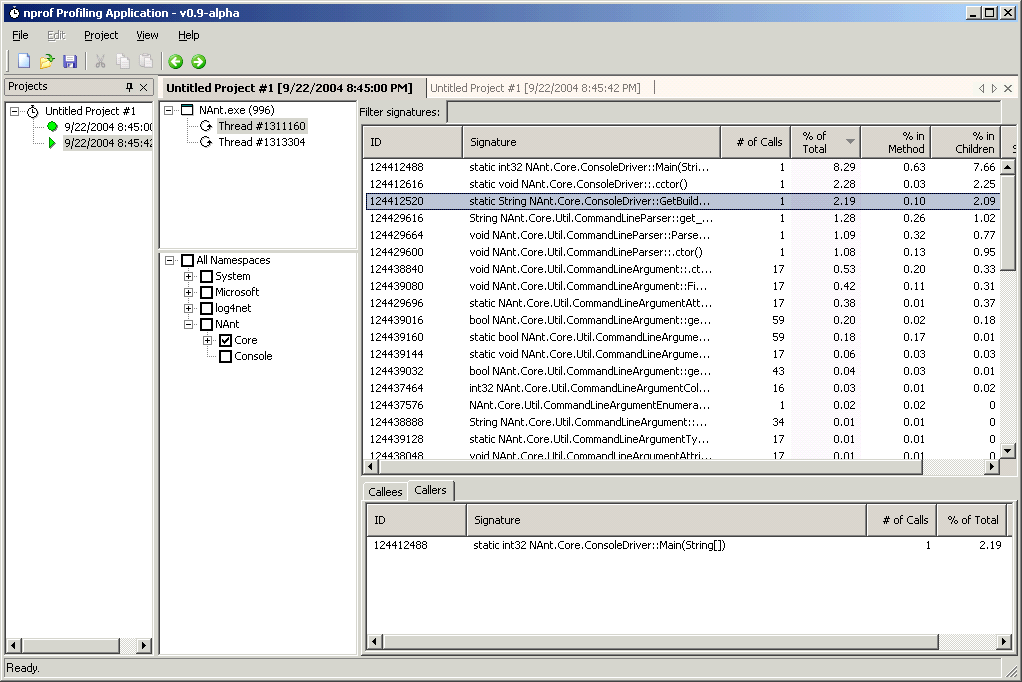
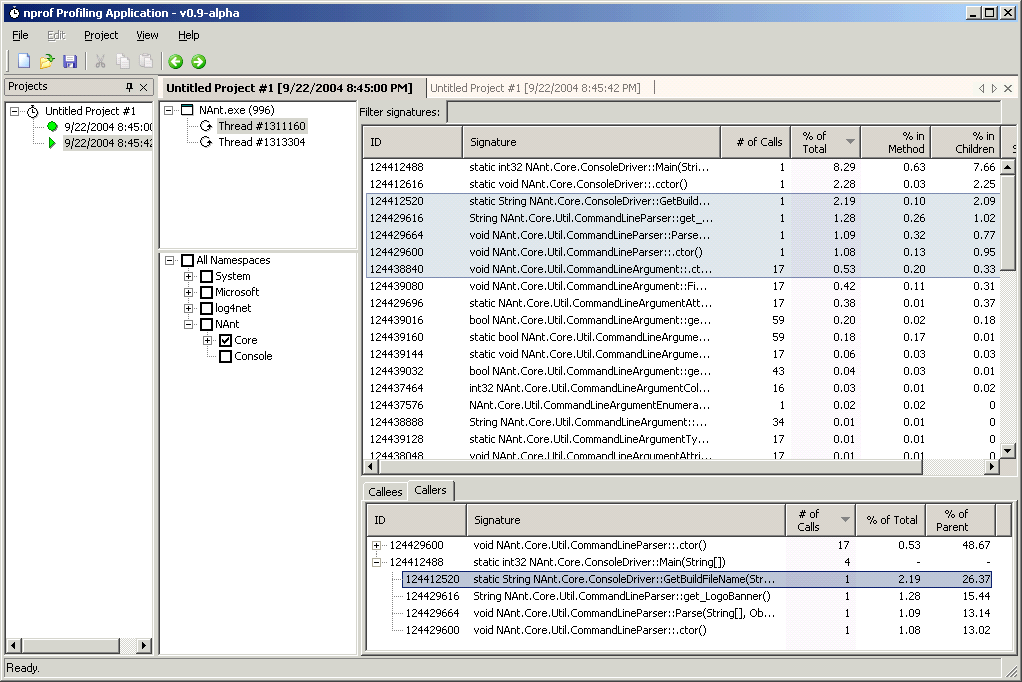
The nprof 0.9 alpha release is now available. This release will fix the problems with profiling .NET applications that spawn other .NET applications, as well as improving the GUI in a number of places.
Here’s some screenshots from the new release:
Cabinet Checklist, Take Two
I’ve been doing bits of work here and there on the cabinet. Here’s my revised phase one to-do list with completed items crossed out (they may not appear crossed-out in my RSS feed). Stuff that I decided not to do, or decided to modify or added since the last list is in red:
Stage One: Construction
Firefox 1.0rc Rocks
I’ve been surfing with Firefox 1.0 for a few days and it absolutely rocks. Some of the really cool stuff:
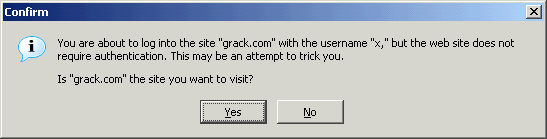
- Anti-phising protections for user:pass URL sites. IE manages this by stripping off passwords while Firefox still allows you to visit:
- The “find as you type” bar comes up as you’re searching, instead of using the window’s status bar:
Babylon 5: Season 1
Just finished watching Season 1 of B5 on DVD tonight. Chrysalis (the final episode of S1) is fantastic. If you have the opportunity to watch the DVD set, take it!
One of the most interesting things about the series is that it coincided with the birth of the web. The Lurker’s Guide to Babylon 5 was probably one of the first pages I hit on the web. Strangely enough, the site is pretty much the same as it was a decade ago- save for some recent updates of course.
CSS Tweaks
My old default style was starting to tire me out. I’ve changed the default font and tweaked some of the general style for the site to spruce it up a bit.
If I feel brave enough, I might just whip up an entirely new set of style and create another dynamic style link at the bottom of the page.
Oh yeah - I’ve also got three more Gmail invites to give away. If you’re interested and happen to notice this, leave me a comment with your full name, email address and website/blog (if applicable).
Gmail Invites
I’ve got gmail invites to give away to the first five to leave their name and email address in the comments.
First come, first serve!
mod_rewrite Saves the Day
I wanted to move all of my old articles into yearly subdirectories, but I didn’t want to break any of the incoming links to my site. Thankfully, mod_rewrite allows me to redirect incoming requests as necessary!
RewriteEngine on

RewriteCond         %{REQUEST_FILENAME} ^(.*/news)/
RewriteCond         %1/2004/$1          -f
RewriteRule         ^news/([^/]+)$       /news/2004/$1 [R,L]

RewriteCond         %{REQUEST_FILENAME} ^(.*/news)/
RewriteCond         %1/2003/$1          -f
RewriteRule         ^news/([^/]+)$       /news/2003/$1 [R,L]

RewriteRule   ^(.+)  -  [PT]
Sharpreader with Embedded Mozilla
I just tried out my Sharpreader via Mozilla hack on the latest version of Sharpreader. It still works!
Firefox .NET Hosting Flicker Fix
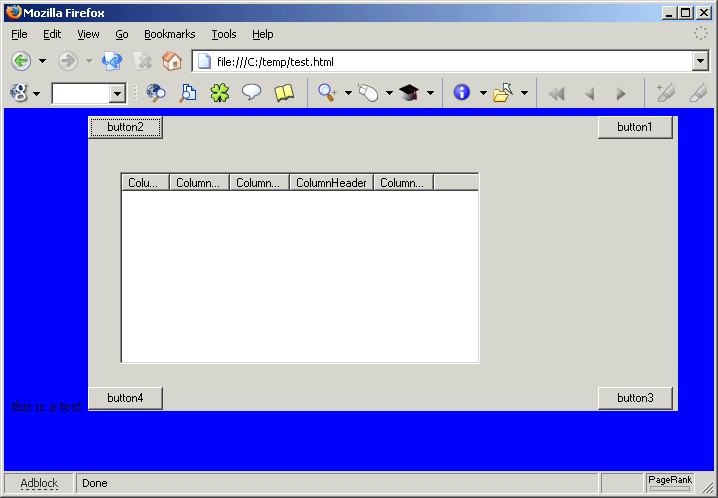
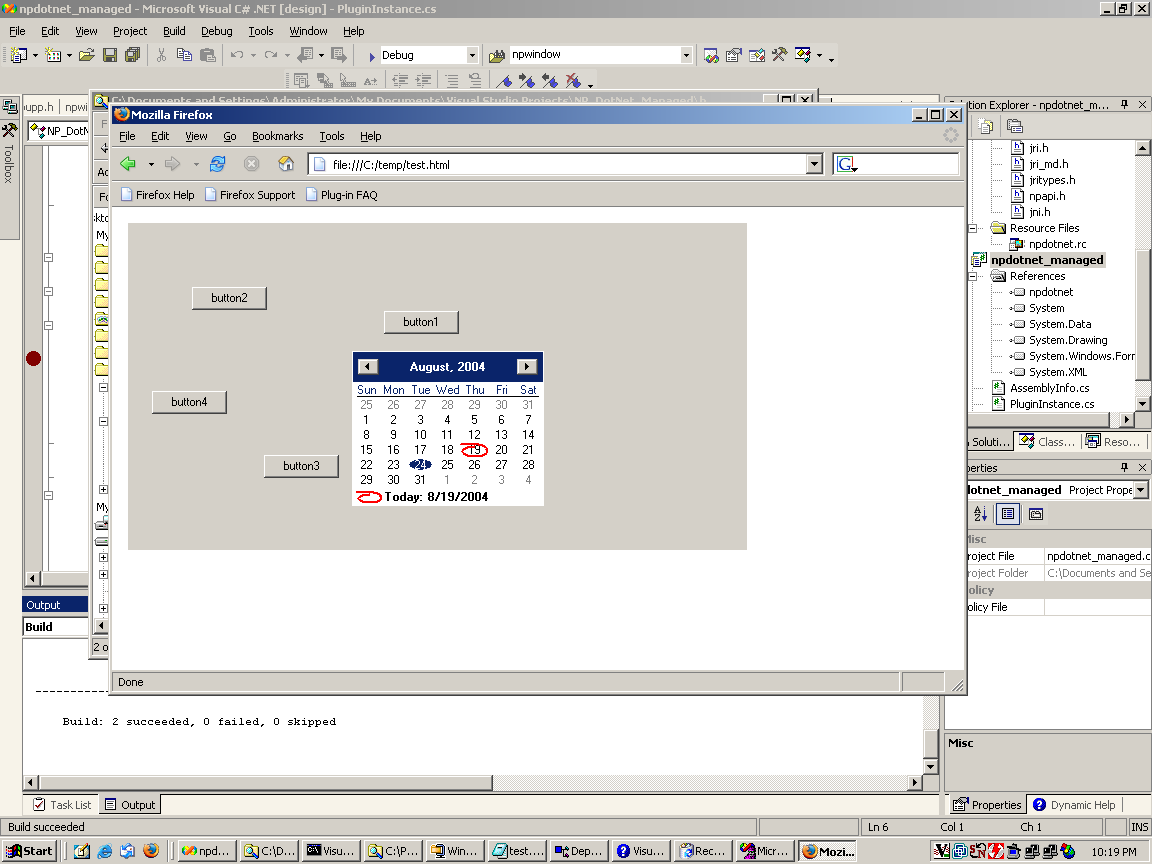
After some playing around with various bits in System.Windows.Forms, I’ve managed to pretty much eliminate the graphical glitches in the .NET control hosting plugin.
The only thing left is some strange WM_ERASEBKGND/WM_PAINT messages that seem to be coming out of nowhere. Whenever I resize the browser I get a subtle flicker on some controls - it’s almost like the entire control has been invalidated by something. Perhaps the Gecko plugin hosting window is doing this to force a refresh on any plugins.
Here’s another screenshot for fun:
Firefox Hosts .NET Controls!
I managed to get my .NET plugin wrapper for Firefox working just now. I can get a .NET UserControl to show up embedded in an HTML page through Firefox.
Next step - hook up the <object> tag to download arbitrary .NET assemblies and run them as UserControls (with security of course).
Check it out!
New Google Zeitgeist Out - No Browser Stats
Google has released their latest zeitgeist, but this time without the browser stats of yore.
I was hoping to see a rise in Gecko-based browsers for July, but I don’t think we’ll be seeing it for a few months. Could this be related to the IPO?
Firefox Promotional Buttons
As part of the latest Mozilla Firefox grassroots marketing blitz, I received a personalized email message from Blake Ross. I have to admit, a non-form letter really does make a good impression.
To be honest, I’d been thinking of adding it before but this gave me the last little push to add it to my front page. I might find a different spot for it later on, but it looks really good where it is right now.

UPDATE: If you’re looking for a button for your own site, check out the Mozilla Firefox - Promotional Buttons page. The little guy they have there ( ) is really nifty.
Fun with T-Moulding
I started applying the T-moulding to the edges of the cabinet today. It took a little while to figure out the right height for the router but it goes quickly once you’ve got it set right.
I managed to cut the moulding slot too high or too low in a few places - I’m using “No More Nails” to hold it in. If this doesn’t work I’ll probably try picking up a hot glue gun (a suggestion I saw elsewhere).
I’m pretty close to getting the cabinet sides attached (once the rest of the shelving supports are in). This should be a virtual milestone for myself - it’s tough to see the pieces lying around unassembled for so long.
UPDATE: Looks like I’ll need a glue gun after all. Home Depot, here I come!
RSS Needs an Acceptable Use Flag
RSS (and Atom) should come with an acceptable use flag that lets me tell people that it’s okay to syndicate my blog posts in full.
For future reference, it’s okay to quote or aggregate any of my posts, even in full.
Copyright Economics
There’s an interesting Wiki discussing Copyright Economics. It breaks down the interaction between producers and consumers of “intellectual property”, comparing it with the interaction between buyers and sellers of physical goods.
From what I can tell of the analysis, a “social gain” is equivalent to saying that the extra money that the producer gained over the minimum they would have done it for plus the extra money that the consumer has that they didn’t need to use to buy what they wanted results in extra money for everyone!
The interesting conclusion is that pirating IP actually results in a social gain in the short term, while in the long term can potentially result in a social loss:
Cabinet Checklist, Take One
Okay, gotta make myself a checklist so I can finish this project up in a reasonable amount of time. It looks like a lot, but I can usually take out a number of these in a day.
Did I mention that a MAME cabinet requires a huge amount of commitment?
Stage One: Construction
Starting Assembly + Some Misc Thoughts
Started putting together the MAME cabinet on friday. I managed to get as far as assembling the base. Since it’s such an integral part of the entire cabinet, I spent a bunch of time with tubes of No More Nails and some good wood screws to make sure nothing moves.
It supports me standing on top of it- hopefully it’ll support the weight of the cabinet and the TV (which probably weighs twice as much as me together!)
Fancy tip: pre-drilling all of the screw holes should ensure that none of your wood splits.
Yet More Cutting
I took the cabinet sides and used the circular saw to clean up some of the nastiness I left by using a spinsaw. The trick is building a jig using a straight piece of wood and an aluminum guide. You can use one edge of the wood to line up your cut and then use the aluminum to guide the saw in a straight line.
I also got the top of the control panel cut. By the time I started I was getting pretty tired and really messed up the first cut. Thankfully you can fix most cuts with more cutting.
More MAME Cutting
Lots of cutting involved in creating a MAME cabinet. This last weekend I managed to cut out the two side panels using my brand-new spinsaw from Canadian Tire. It’s a sweet tool - a bunch of different rotary tools in one. Like a Dremel, but more heavy-duty.
iPod + iTrip = iLove
Thanks to the nice guys at Brightspot Consulting and their “win an iPod draw”, I’ve come away with a brand-spankin’-new 15Gb iPod. First thing I did was get myself one of those amazing* *iTrip FM Transmitters from Griffin Technology.
These devices together make up an amazing one-two combo of convenience. To get music working in my truck, I just pop the iTrip into the iPod, hit my iPod station preset and go. As long as you keep the iPod’s volume around 70-75% you’ll get a crystal clear signal. I tried using a cassette-tape-adapter at first, but this is by far more convenient.
You should be able to find the iTrip at your local Mac dealership.
Married Now
Been busy over the last few weeks as we get married, took a week off hidden in the mountains of BC and then returned to Calgary to get back into our regular groove. It’s been really hectic but a lot of fun.
nprof and ACT for profiling
Happy Canada Day! Klaus Salchner authored an excellent article on using NProf and ACT for profiling. It’s a good introduction to profiling and optimization techniques.
Still working on 0.9, but there’s not a great deal of time to get it polished for a release. Since there are thousands of downloads for 0.8b, I want to make sure that 0.9 is stable for general use.
Forumzilla for Thunderbird
From a suggestion in one of asa’s posts, I just took a quick look at Forumzilla. My first impression is that it’s a pretty cool concept - it would allow me to reduce my number of running applications by one. I’ve been running SharpReader for some time and it’s certainly a memory hog, especially when you get a fair number of feeds in it.
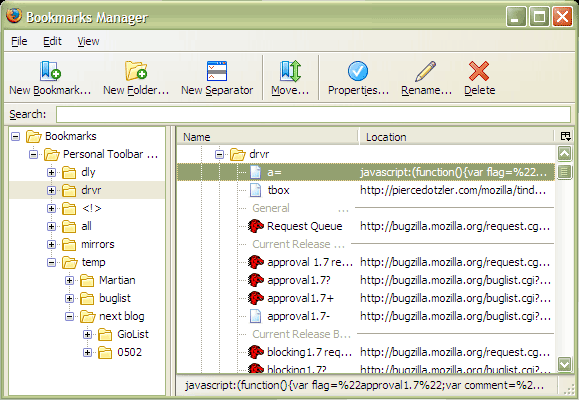
Forumzilla has a different concept than SharpReader, however. Instead of each feed having its own, individual, leaf-type folder, Forumzilla lets you pick one of your mail folders to drop a particular feed in. While this is a cool concept, I think I would prefer to have something similar to the new bookmark manager for handling the feeds:
Software Storage Virtualization?
Is there a good cross-platform, storage virtualization application available? I want a magical, automatically-clustered-and-redundant service that concatenates all of the free space within an entire network into a single “megadrive” and makes that available as a shared drive to all systems.
Ideally, it would allow you to “hotswap” computers in and out of the ad-hoc array, mirroring the data between nodes as necessary to ensure that more than one copy of all data is available at all times. I suppose this is similar to the approach that Google has been taking with their distributed file system.
Far Cry in Transgaming Cedega
Far Cry works great in Transgaming’s Cedega. Chalk up another (recent!) game for Linux.
Make sure you use the Loki Installer rather than the .msi-based setup program. It’ll copy the files to the correct spot on your drive and create a launcher executable for the game. Fire it up and enjoy!
Get the (so-called) Facts
I keep seeing these so-called “Get the facts” and they’re ticking me off with their blatant misrepresentation of facts.
The one I just saw compared the price of Mainframe Linux with the price of Windows Server 2003.
Uhh… isn’t that a little unfair? What about comparing PC Linux with PC Windows Server 2003? Are they afraid to do this thing head-to-head on the same platform? If you read the test, they are using Samba 2.2.x and Apache 1.2.x - not 3.0.x and 2.x, the latest versions respectively. Wouldn’t it be fair to compare the newer versions of the applications with Windows 2003? Or perhaps the older versions with the equivalent of Windows 2000?
.NET ThreadPool Woes
I discovered a deadlock in some code using the ThreadPool to do some database connectivity tests. It turns out that some of the database code in the .NET framework uses the thread pool to get database connections. This results in deadlocks when spawning too many threads trying to open database connections.
Microsoft needs to add a parameter to the QueueWorkItem method that specifies the approximate number of additional threads needed by a work item. This could ensure that the appropriate number of threads were free before starting the item.
Looks like it’s back to the custom thread pool implementation again….
Transgaming Cedega Rocks
Fired up WineX 4.0, aka Cedega, to play some Tribes 2 tonite. What an amazing accomplishment - it runs perfectly, and fast to boot!
Running Windows games under Linux: one more reason never to dual-boot.
My Adblock Patterns
Here’s some home-grown Adblock patterns for your enjoyment (save as “adblock.txt” and use the import option on the Adblock preferences screen):
[Adblock]
http://*.atwola.com/*
http://*.atdmt.com/*
http://i.cnn.net/*.js
*/partner_backlinks.js
http://*.googlesyndication.com/
http:/*.imrworldwide.com/*
http://*.questionmarket.com/*
http://*.bluestreak.com/*
http://images-aud.slashdot.org/*
http://ads.*.com/*
http://*.tribalfusion.com/*
http://*.serence.com/*
http://*.burstnet.com/*
*advert*
http://*.tangozebra.com/*
http://ads.*/*
http://*.doubleclick.net/*
http://*.adtech.*
http://*.subsitesadserver.*
http://*.msads.net/*
http://us.a1.yimg.com/*/a/*
http://*.cecash.com/*
MAME Cabinet Woodworking
I managed to get the majority of the wood cuts done for my MAME cabinet today. It took about an hour to mark each piece out, then about two hours of clamping the aluminum guide and running the circular saw.
Before I started the project, I never would have guessed how much work it would turn out to be.
The last cuts are going to be the cabinet sides. Fortunately it’s better to cut both sides at the same time - this ensures that even if you make a mistake the cabinet sides will still match.
Morality of Blocking Ads
An interesting comment posted by one of my readers:
Blocking ads is very nice and all, but you do expect most websites to provide free content don’t you? For most content websites, advertisements are the only way to cover their bills (and maybe even make a little profit). If you and everyone else block these advertisements, content websites will either have to close or go paid-subscription only. Would you like this? I think not, so how about uninstalling that Adblock extension, and viewing a few advertisements now and then?
Dennis assumes that I have some moral obligation to view ads on a site because I am viewing the site itself.
Why you should use Firefox + Adblock
CNN.com, before and after installing Adblock.
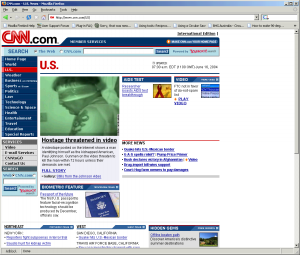
It takes a bit of getting used to (remember your old DOS wildcard days?), but it’s pretty easy to come up with good patterns to block 90% of all ads within about 20 minutes.
Firefox 0.9
In a word - still really amazing! Oh wait, that’s three. Well, Firefox sure deserves all three anyways!
Install it today - even though the promise of automatically installed spyware sure is mighty appealing.
.NET Desktop Apps - Slow & Bloated
I’ve got a couple of .NET desktop apps running on my work system (with a gig of RAM nonetheless) and it seems like they are always the applications that are sucking up the most memory.
I run Sharpreader at work for a couple of interesting feeds and it hovers around 70MB when open! Minimizing it seems to reduce the working set to 2MB, but it’s still using 69MB of virtual memory while sitting there.
A GUI monitoring tool that I wrote for Draco.NET seems to take up 30MB (plus 30MB of swap) all the time while it’s sitting in the taskbar. It’s basically just a WinForms app that calls a remoting service - no fancy tricks.
Fixing Firefox Winstripe Spacing
All my readers, please note that this is constructive criticism (as well as a fix!) for the new theme, not an emotional rant or complaint. Ben Goodger has done an awesome job in getting Firefox ready for 0.9.
The first time I fired up Firefox 0.9, I wasn’t too happy with the new, default Firefox theme. However, It turns out that it mostly the awkward spacing that was making the icons look out-of-place. As strange as it seems, reducing the spacing makes the entire theme look a lot better.
Big Flames Game Tonite
The underdog team has made it to game 7 of the finals. “Flames fever” has pretty much devoured the city.
We’re in for a game tonite.
Source Control for the 21st Century
Having been using CVS for the last four years in a commercial environment, I’m certainly pretty comfortable with it. Branching and merging is tricky (sometimes painful) as usual, but losing file history on rename is a killer. WinCVS has been the gravy on top that keeps us using CVS. Anyone who might have had the misfortune of trying to work with command-line rcs or cvs knows how much more productive a GUI makes things.
I’ve been evaluating alternatives in the next generation of free SCC applications. Given the above issues I’ve had with CVS, my requirements are:
IntensIT
Myself and a number of co-workers entered the IntensIT competition here in Calgary. The competition is designed for IT workers, the goal being to write as much of a complete system as possible within eight hours.
We ended up taking 1st-place overall thanks entirely to the excellent meshing of our team. I suppose this proves that methodology doesn’t matter whatsoever, but people do… at least when you’re creating an entire system in eight hours, that is.
Oh yeah- using NUnit, NAnt, Draco.NET and CVS really do make your life easier when you’re under the gun.
You can see the other winners here.
Easy News Server with Cyrus-IMAPD
I’ve been playing around with Fedora Core 2’s Cyrus IMAP a bit and discovered the cyrus-imapd-nntp package. This lets you export a shared IMAP folder via NNTP. The cool part about this is that it’s a standard IMAP folder, like every user’s INBOX and custom folders.
This means that to set up a newsgroup, you only need to run cyradm and enter the following commands:
cm netnews.some.newsgroup
setacl netnews.some.newsgroup group:users post
Assuming you’ve added newsprefix: netnews to your imapd.conf, this will add a new newsgroup “some.newsgroup” and give everyone post permissions.
Study Shows WMA Not That Great
Looks like Vorbis walloped WMA on the Multiformat listening test.
If you’re interested in how the test was run, Roberto Amorim has a page with all the details.
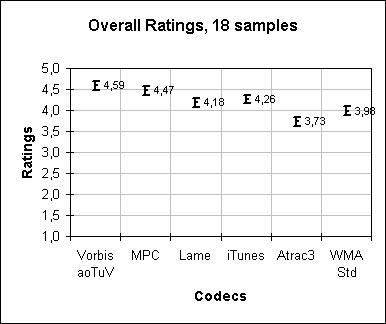
Personally I’m still using MP3s as my primary ripping format as it’s the format supported by pretty much every piece of software and hardware out there. After this, I’m considering switching to Vorbis. Unfortunately, I’ll have to give up my coveted iTunes at work unless I can find either a plug-in for Vorbis music or an iTunes clone (for Windows) that supports it. Any hints?
Fedora Core 2
I’m performing the task of apt-get dist-upgradeing to Fedora Core 2 as we speak. The biggest reason is that I can’t get the latest development 2.6.5/2.6.6 kernels to boot on my system. It’s freezing right after the “freeing kernel memory” line (trying to find /sbin/init, I assume).
I’ve found a thread on Google Groups potentially related to this issue, but I haven’t tried out the patch mentioned.
QEMU Reloaded
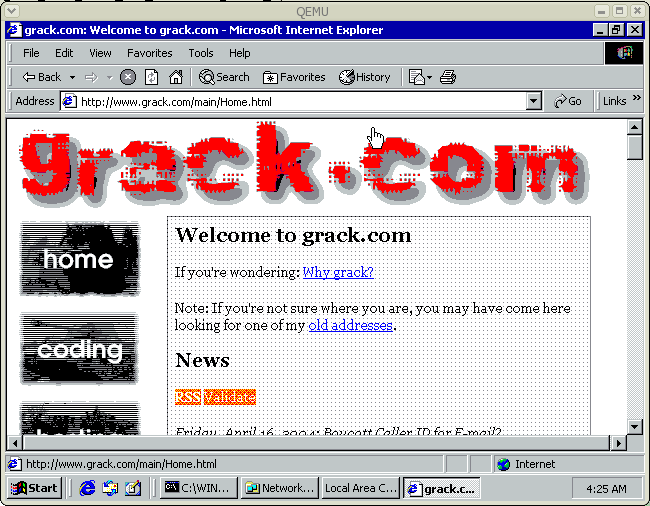
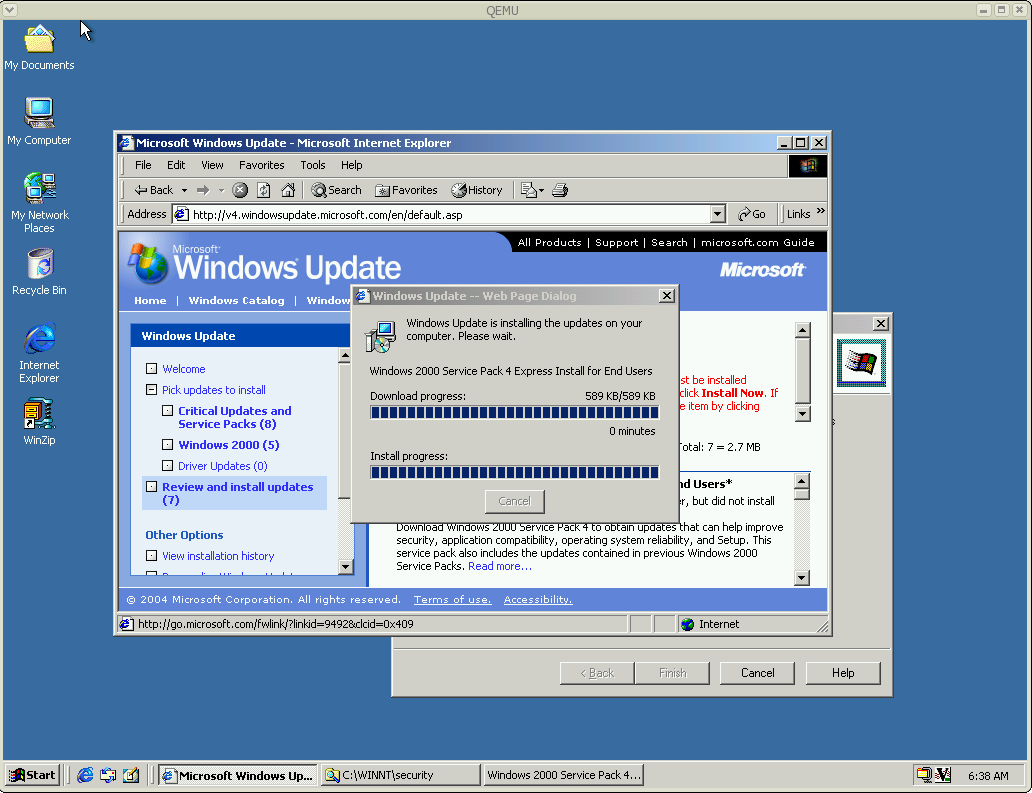
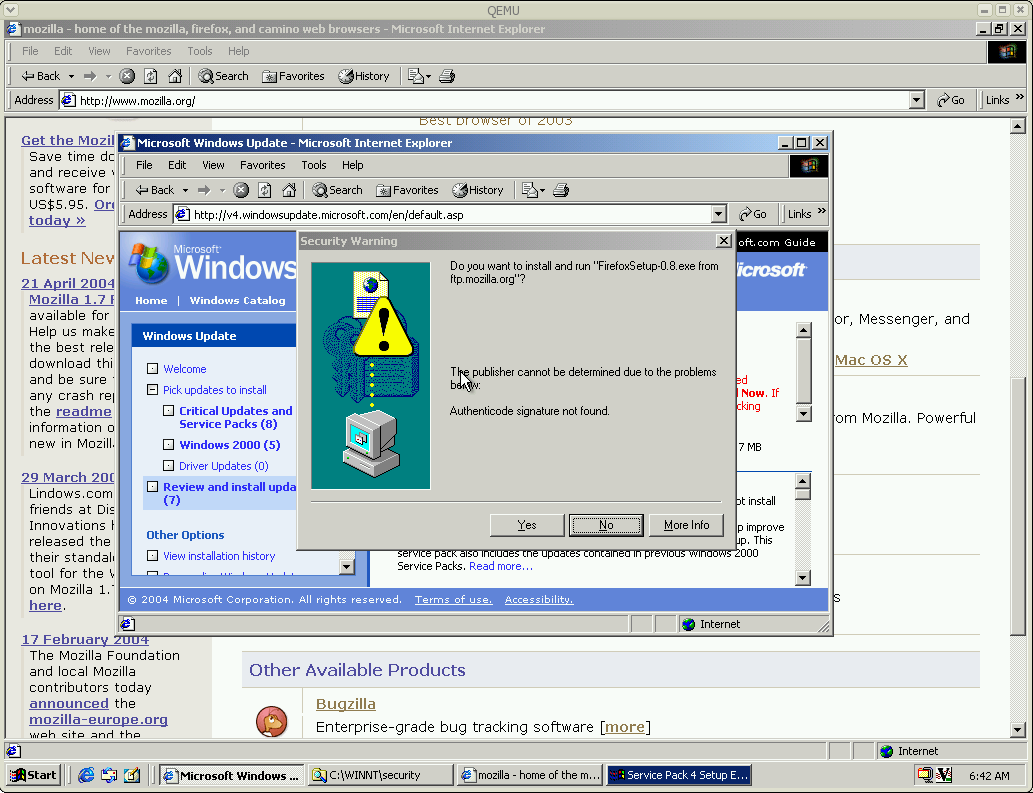
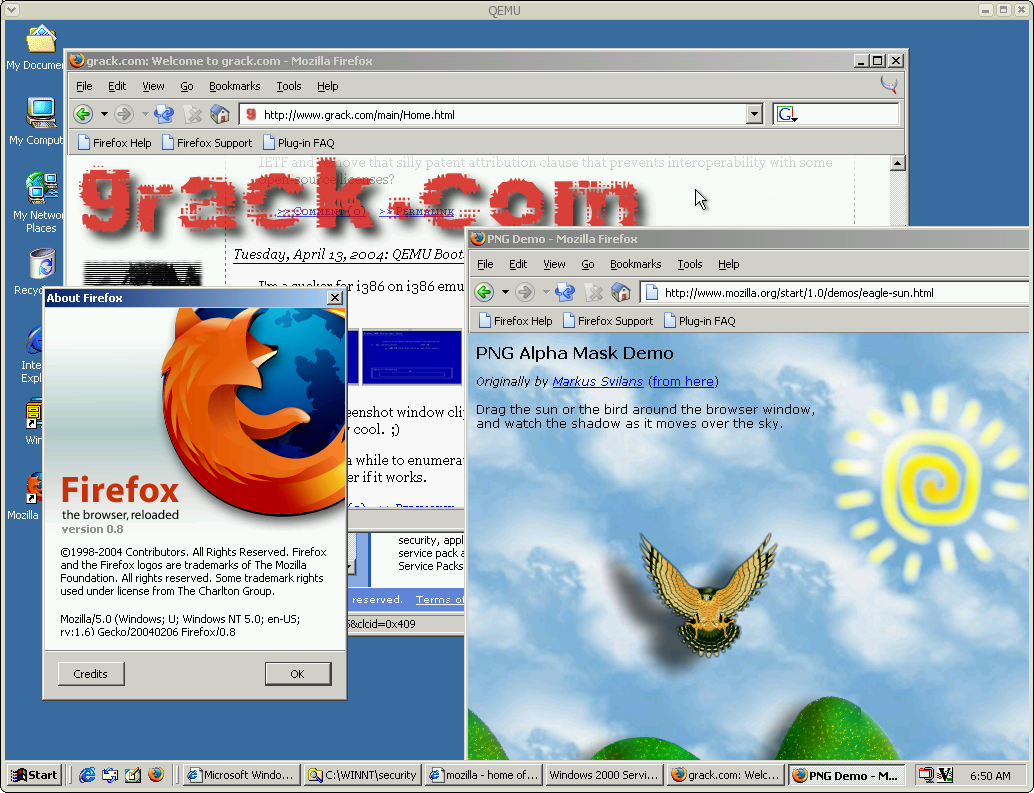
With the latest release of QEMU (0.5.4), it now boots Win2k perfectly. I’ve fixed a small bug in the code preventing the Bochs VBE display driver from working and the full-color support looks awesome. All but the first screenshot are running 1024x768x16bpp visuals.
Note that XP should boot full-color fine without the patch since, AFAIK, it has full VESA 2.0 support built-in. You should be able to get 8-32 bpp visuals from the default Standard VGA driver.
Also, notice that QEMU runs Firefox flawlessly. It’s a good test for full-color screens.
Draco.NET Gets a GUI
Are you a .NET coder? Using continuous integration, or want to? If so, check out Draco.NET.
Draco.NET now has a client-side GUI. It can monitor your check-in builds and trigger a forced or normal build. It sits in your system tray and hides itself when not needed.
You’ll need to build Draco from CVS to get this particular feature. With any luck, there will be a 1.5 release soon and 1.6 betas soon after!
QEMU Boots Win2k
I’m a sucker for i386 on i386 emulation. Check out QEMU booting Win2k in Linux:
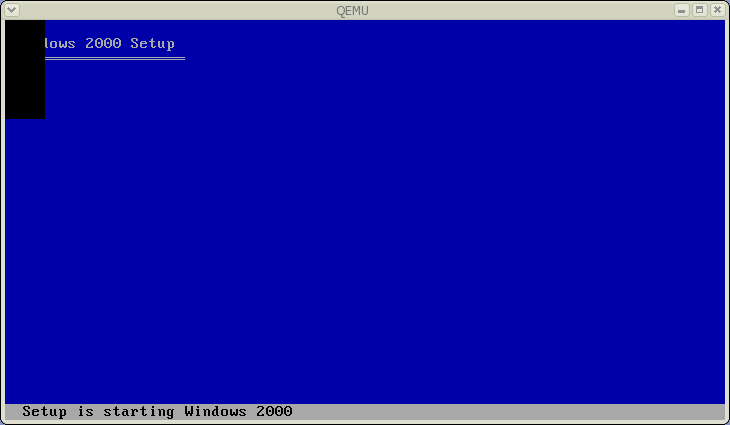
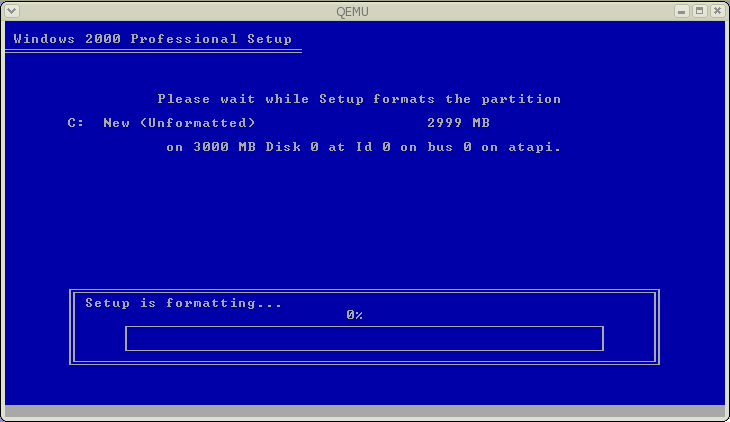
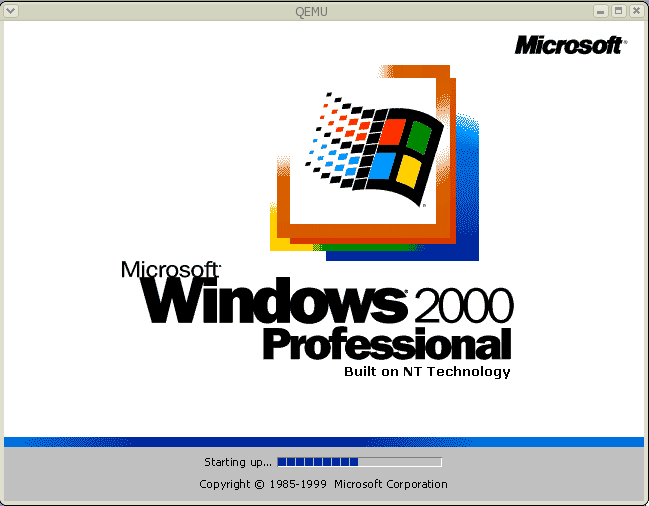
I think the screenshot window clipped the first shot by accident as it was coming up. Oh well. Still very, very cool.
Seems to take a while to enumerate devices after install (still happening right now). I’ll post more shots later if it works.
Cool Firefox Extension Idea!
Okay, I’ll admit it. My mind is racing with extension ideas right now. May as well dump one here for future reference.
So, here’s my cool extension idea: take all of the bookmarks in the browser and sync them with a central server via a webservice. Allow deep custom categorization of bookmarks and keep the folder structure on the server. For extra credit, archive a current copy of the page for future reference if the page goes away. If you have extra time, write an IE plugin (or external program) that does the same thing.
Now, where to host such a webservice?
IE6 for Linux
Wow. You can run this script to automatically install IE6 in Linux.
Organizing Filters in Thunderbird
It took me a while to figure something out that works, but I’ve figured out a way to organize my filters in Thunderbird. Since I have something like 40 rules, editing and understanding them was started to become difficult.
My solution? I started adding fake filters as separator lines between the groups of filters. They now look like this:
--- People Filters ---
Person A
Person B
--- Mailing Lists ---
List A
List B
--- Miscellaneous ---
Spam
Viruses
Shazbot! Tribes 1 and 2 for Free
Vivendi Universal is releasing, for free (gratis), two of my favorite games ever: Tribes 1 & 2. This release is geared at getting games’ juices fired up in anticipation of Tribes 3.
I’m glad to see that people realize that freeing abandonware can be useful.
Evangelism: First Firefox, Now Thunderbird?
After installing Mozilla Thunderbird yesterday, all I can say is “wow!” Not only is the look ultra-slick and refreshing, but it’s so fast that it really does deserve to be alongside an amazing browser like Firefox. They’ve done such a great job that people nearby just start using it without even saying anything.
Before Thunderbird I wasn’t willing to push the Mozilla mail client on anyone. I was using it before and, while it was fast, it looked like a relic of the Netscape 4.0 days. As well, you needed to match it with the Mozilla browser. Also fast, but not an end-user polished package.
Multi-Session X and Project Utopia
rml posted some use cases for Project Utopia. If they can solve these issues smoothly (which I’m pretty sure they’ll pull off), Linux will take a big jump in terms of general plug’n’play usability.
Unfortunately, the use cases miss out on one of my favorite new features - multi-session X. You can easily start two X servers on two different virtual consoles right now, but the new gdm stuff will support suspending and resuming X sessions, as well as nested X servers. This will help Linux catch up to the cool multi-user login features of Windows XP.
Canadian Court Squashes Recording Industry
Looks like the Candian Federal Court has decided in favour of the anonymous John and Jane Does in the recent file swapper case. The Judge has determined that the following criteria must be satistified for a disinterested bystander to be compelled to aid in discovery as a third party. In the case of the recording industry versus KaZaa users, this means that the ISPs would be releasing the confidential customer data that would map a user’s IP to his home address.
MAME Cabinet: Purchasing Wood
Just bought the necessary wood for the cabinet today. It was a pain to load up on the truck - the wind was ferocious!
Here’s a tip for anyone looking to build a MAME cabinet: get the big, straight cuts done when you buy the wood (if possible). It cost me CDN$0.50 a cut - worth it to reduce the number of long cuts that I’ll have to make myself.
Total cost so far is CDN$120.
Circular Saw - Preparing for the MAME Cabinet
Just bought a circular saw today in preparation for building the MAME cabinet. The guys at Rona/Revy are nice enough to explain the basics of cutting and the pieces I’ll need.
My plan of attack so far is:
- Cut all of the required pieces of wood (from the plans I’m using)
- Draw out the control panel layout from my sketches
- Purchase required control panel electronics
- Assemble control panel and test with regular PC
- Paint, add T-channel edging to all other wood pieces
- Assemble the rest of the cabinet pieces
- Attach control panel to cabinet
- Figure out computer and TV bits to make it a real, working cabinet
VS.NET and NAnt
I was playing around with getting NAnt to build all of our VS.NET projects today - it’s much more pleasant to build 90+ C# projects using an XML-based build script than with VS.NET’s native build system. I highly recommend anyone with more than a few dozen projects to consider using it!
It’s a bit of a pain to get around some of the VS.NET locking issues, but once you’ve got it figured out, you’ll be thankful.
Design for Firefox, Hack for IE
I’ve decided to tweak my default stylesheet a bit to use some fancy features available in Firefox (and any other highly compliant browser). As usual, I’ve designed the effects for Firefox and just made the site work with IE.
Here’s a rundown of the stuff I did:
- Added position: fixed; to the header above and navigation bar on the right so that they stay on the screen.
- Added real transparency to the logo.
- Added a transparent gradient background to the header, underneath the logo.
These effects are all available in any browser besides IE. I’ve used the conditional comments to set the body class depending on whether the browser is IE or not:
Clemens, part 2
Thanks for the response, Clemens. I love a good debate.
After reading the response to my letter, I’ve finally discovered the argument that Clemens Vasters is trying to make. It’s not that sharing is the problem - it’s that people are making money off the work of these duped open-source kids that get nothing in return.
He’s hidden his point underneath a cloak of hatred for open-source evangelists and companies, calling the companies that profit off open-source the selfish ones. Unfortunately, this is the result of not understanding the open-source ecology I mentioned before works whatsoever, despite his claims.
Where do you want to go, Clemens Vasters?
In response to “Where do you want to go, Aiden?”:
Dear Clemens,
I’ve never spoken with you in person, and probably never will, but I feel compelled to answer your public letter on behalf of your friend, Aiden. I found it difficult to extract your argument from your letter, but I’ll chalk it up to not understanding exactly what open-source is, or why people would ever consider sharing the fruit of their time with others.
I have a simplistic view of open-source that might make sense to you:
Wiring an Encoder to the I-PAC
I’ve finally figured out how to wire up an encoder (ie: a knob) to a keyboard emulator like the I-PAC. Easy logic - a flip-flop, some AND and NOT gates. Extra credit: redesign this logic to replace AND and NOT with NAND.
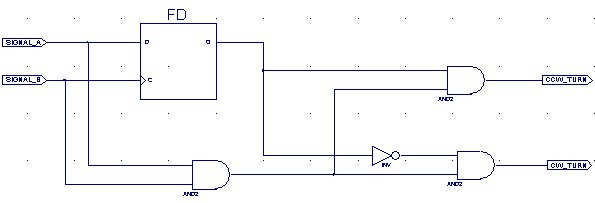
I knew that electrical engineering degree would come in handy at some point! Here’s the waveform it produces:

Building a MAME Cabinet
I’ve been tossing the idea of building a MAME cabinet around in my head for a while and I’m getting close to decided whether to do it or not this summer. I’m hoping that with enough planning, it should be a smooth enough project for me to complete during the warm months here in Calgary.
MAME Cabinet Control Resources
Three interesting places I’ve found for purchasing arcade-quality controls:
Right now, I’m investigating various control-to-USB converters.
Happ Controls has the “USB Game Control Interface” for US$185. This interface can convert two 8-way joysticks, six buttons for each joystick, a three-button trackball, a couple of start select buttons and some coin counters. It looks like it would do everything I’m looking for, but the price is pretty steep.
Mozilla Firefox - Switch!
The Mozilla Firefox 0.8 release has been so popular that it’s making a number of the main download sites for the browser and extensions, such as ftp.mozilla.org and mozdev.org, extremely slow. As the Mozilla community grows, there’s going to be an ever-increasing need to have a solid infrastructure in place to support the increasing amount of traffic.
I’m impressed with the number of people that have started using this browser - people who I would have never expected to switch have done so. You never hear the words “this site doesn’t work in Firefox”.
Unit Testing Redux
I’ve been a big fan of unit testing for a while (ever since the first releases of JUnit) but I haven’t been up-to-date with the latest technology. To be perfectly honest, I hadn’t expected anything else to appear after unit testing was first popularized. That’s why I was surprised to come across an off-hand reference to “Mock Objects” a few days back. Basically, Mock Objects are a true way to test an object “in a box” - ie: completely separate from the rest of your system.
Stereo Anaglyphs from Mars
I’ve had trouble with a lot of the stereo anaglyphs that NASA’s been publishing. Most of them seem to have a stereo separation that is completely incompatible with my brain. I finally found a few images that actually work with my red/blue glasses (from this page):


The trick is to tilt your head just right. If you find that you’re seeing a lot of shimmering, trying relaxing your eyes and focussing on infinity - it’ll be easier to find the correct head angle that way. Oh yeah - move the mouse pointer off too.
Ideas and Ideals
… fantasies have to be unrealistic. Because the moment, the second you get what you seek, you don’t, you can’t want it anymore. In order to continue to exist, desire must have it’s objects perpetually absent. It’s not the it that you want; it’s the fantasy of it. So desire supports crazy fantasies. This is what Pascal means when he says that we are only truly happy when daydreaming about future happiness. Or why we say the hunt is sweeter than the kill, or be careful what you wish for. Not because you’ll get it, because you’re doomed not to want it once you do.
So the lesson of Leccan is, living by your wants will never make you happy. What it means to be fully human is to strive to live by ideas and ideals, and not to measure your life by what you’ve attained in terms of your desires, but those small moments of integrity, compassion, rationality, even self sacrifice. Because in the end, the only way that we can measure the significance of our own lives, is by valuing the lives of others.
nprof 0.9 plans
Just to keep those reading the front-page news up to date, 0.9 is in development and should be out once we’ve finishing implementing and polished up some of the neat new features that will be in this release:
- Josh’s awesome new ListView control - including, but not limited to:
- quickfiltering
- custom and multi-line headers
- column reordering
- generally nicer look than before
- Project loading/saving (also courtesy of Josh)
- Ashwin’s back/forward navigation code
- A new toolbar (hasn’t been started yet, but needs to go into 0.9)
There are two known bugs that I’m hoping to get fixed for 0.9 as well:
Mixmaster on Websites
Just saw this one on boing boing - Mixmaster.
[It] allows you to ‘mix’ two entirely different webpages.
The whitehouse.gov meets AOL HAXXOR has got to be one of the funniest things I’ve ever seen. Slightly amusing is Microsoft meets TheOnion and Instapundit meets Rense.com.
Should be work-safe.
Tech Blogs and Politics (and Other Non-Tech Related Posts)
Twice this week I’ve seen a situation where a popular blogger has been pestered by his readers to change the content of his blogs.
Last week, Chris Sells (of MSDN fame) posted an article entitled “Bush: Get Your Own Dream!” with his views on space exploration and foreign oil dependence. There were two particularly asinine comments made:
Unsubscribed. Just lost a ton of respect for Sells. “nuff said”
and
nprof 0.8b released
The nprof 0.8b alpha release is now available. This release should fix the ASP.NET profiling problems that have come up during the 0.8 release cycle.
nprof 0.8a released
The nprof 0.8a alpha release is now available. This fixes two bugs in the 0.8 release:
- nprof wouldn’t close completely when clicking on the close box
- ASP.NET profiling wouldn’t work if you didn’t have an Environment key for your W3SVC or IISADMIN services
NOTE: I recommend setting up ASP.NET to run under the SYSTEM account for profiling only. Once you’ve finished profiling, you should set it back to use the “machine” user. As before, these XML attributes are available in your machine.config file.
nprof 0.8 released
The nprof 0.8 alpha release is now available. Changes in this version are:
- Basic ASP.NET profiling - note: ASP.NET must be running as SYSTEM!
- Profile run message display
- Detection and graceful handling of failed profiling runs
- New icons for application and successful project run
- Drag-and-drop of executables to the project tree (Josh)
To profile your ASP.NET application: